
Altay: Dawn of Civilization
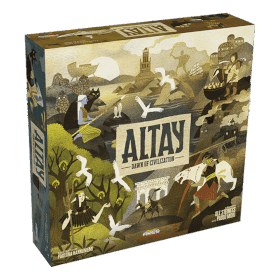 Dirigez l'un des peuples anciens d'Altay et faites face à l'arrivée des colons humains dans vos terres ancestrales.
Décidez si vous souhaitez adopter leurs innovations ou maintenir les traditions anciennes tout en étendant votre royaume, en cultivant le savoir, en construisant des monuments ou en vainquant des ennemis.
Altay: Dawn of Civilization est un jeu de construction de decks de civilisation se déroulant à une époque mythique. Dans une région reculée d'un vaste continent, quatre sociétés mystérieuses ont cultivé des cultures distinctes au fil des siècles, préservant un équilibre fragile. Elles sont désormais confrontées à un nouveau défi : l'afflux de colons humains dotés d'armes et d'artisanat sophistiqués.
En tant que chef de l’un des peuples anciens de l’Altay, vous avez le choix de la manière de réagir à ce défi.
Le plateau de jeu représente une région où les quatre factions s'affrontent, chaque zone étant caractérisée par différents types de terrain et de ressources.
Les joueurs contrôlent l'une des quatre factions, chacune représentée par un deck de départ unique, qui se distingue par le nombre de cartes « de base » et de cartes spécifiques aux factions.
À chaque tour, les joueurs utilisent leurs cartes pour générer des ressources, ériger de nouvelles colonies, s'étendre sur le plateau, engager des manœuvres contre des adversaires ou obtenir de nouvelles cartes pour augmenter leurs decks, symbolisant l'intégration des Anciens avec les nouveaux arrivants et leurs métiers.
Nombre de joueurs: 2 - 4
Durée de la partie : 76 mn
Complexité : 3 / 5
Jouez à Altay: Dawn of Civilization ou à 1408 autres jeux en ligne.
Sans téléchargement, directement depuis votre navigateur.
Avec vos amis et des milliers de joueurs du monde entier.
Gratuitement.


Jouez à Altay: Dawn of Civilization ou à 1408 autres jeux en ligne.
Sans téléchargement, directement depuis votre navigateur.
Avec vos amis et des milliers de joueurs du monde entier.
Gratuitement.
Résumé des règles
Decks de départ
- Terriens : Colon, Mineur, Chasseur x3, Village x2, Guerrier x3
- Elfes : Chasseur x5, Maître du savoir x2, Village x1, Guerrier x2
- Gens du feu : Chasseur x3, Chaman x1, Village x2, Guerrier x4
- Petites gens : Artisan (Bois) x1, Artisan (Pierre) x1, Chasseur x4, Tisseur de sorts x1, Village x1, Guerrier x2
Tour de jeu
Durant votre tour, vous pouvez jouer les cartes action de votre main ou utiliser l'effet de toute carte que vous avez précédemment jouée sur la table. Vous pouvez effectuer les actions ci-dessous dans l'ordre que vous souhaitez :
- produire des ressources
- acquérir de nouvelles cartes action
- construire des implantations
- combattre
- développer des accomplissements
1 Acquérir de nouvelles cartes action
- Vous ne pouvez pas acquérir la même carte action deux fois au cours d'un même tour.
Notez que certaines cartes action ont un coût plus élevé que les autres. C'est parce qu'elles valent 1 PV en fin de partie, comme indiqué dans le coin supérieur gauche de la carte.
- Vous ne pouvez pas acquérir la même carte action deux fois au cours d'un même tour.
2 Construire des implantations
- Vous pouvez construire des implantations :
- dans un territoire où vous avez déjà une ou plusieurs implantations (jusqu'à un maximum de quatre), ou
- dans un territoire libre (sans Marqueur de conquête ni implantation adverse) adjacent à au moins un territoire où vous possédez une ou plusieurs implantations.
- Vous pouvez construire des implantations :
3 Combat:
- Pour initier un combat, vous devez utiliser au moins une carte de votre main représentant une icône d'épée rouge (⚔️). Vous ne pouvez pas attaquer un territoire qui ne possède ni Marqueur de conquête ni implantation ennemie.
4 Attaquer un territoire neutre:
- Un territoire neutre est tout territoire portant un Marqueur de conquête. Sélectionnez un territoire adjacent au territoire neutre qui contient une ou plusieurs de vos implantations. Défaussez des cartes avec l'icône d'épée jusqu'à ce que la somme du nombre de vos implantations dans un territoire adjacent et du nombre d'icônes d'épée sur les cartes défaussées dépasse le chiffre indiqué sur le Marqueur de conquête. Récupérez le Marqueur de conquête. Si celui-ci représente une ressource, vous produisez immédiatement une ressource du type indiqué.
5 Attaquer un adversaire:
- Pour attaquer un adversaire, sélectionnez un territoire où vous possédez au moins une implantation et un territoire adjacent contenant au moins une implantation ennemie que vous souhaitez attaquer. Défaussez une ou plusieurs cartes comportant une ou plusieurs icônes d'épée. Additionnez le nombre d'icônes d'épée défaussées et le nombre de vos implantations dans votre territoire. C'est votre force d'attaque.
Déclenchement de fin de partie:
La fin de partie est déclenchée lorsque l'une des conditions suivantes se produit :
un joueur place sa dernière implantation un joueur n'a plus aucune implantation sur le plateau
Si l'une de ces conditions est remplie, continuez à jouer jusqu'à la fin du tour en cours afin que tous les joueurs aient eu un nombre égal de tours. La partie est alors terminée.
Points de victoire
- Valeur en PV de chaque technologie développée ; valeur en PV de chaque merveille développée (jusqu'à un maximum de 7 points), plus 3 PV si le joueur a complété sa merveille secrète
- Valeur en PV des cartes action dans le deck du joueur
- 1 PV pour chaque territoire comprenant au moins une de ses implantations, plus la valeur du marqueur PV dans ce territoire, le cas échéant
- 1 PV pour chaque implantation adverse capturée
- 1 PV pour chaque tranche de 3 points de Marqueurs de conquête capturés (additionnez leur valeur, divisez par 3 et arrondissez à l'inférieur)
Le joueur ayant le plus de PV remporte la partie. En cas d'égalité, départagez-vous en comparant les scores par catégorie dans l'ordre indiqué ci-dessus (technologies en premier, puis merveilles, etc.).
FAQ
- Pourquoi ne puis-je pas archiver ma carte avec Écriture ?
- Vous serez invité à archiver votre carte à la fin de votre tour.
- Comment puis-je consulter ma défausse ?
- Vous pouvez voir votre défausse en survolant avec la souris l'icône de défausse (l'icône grise) sur le côté. Notez que vous ne pouvez consulter votre défausse que pendant votre tour.