
Double Seven
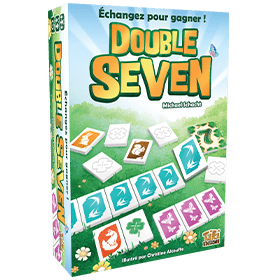 Double Seven est une version moderne du rami classique. Le but est de constituer de grandes séries d'animaux pour marquer des points, sans trop se soucier des animaux choisis : vous pouvez échanger des séries avec d'autres joueurs afin d'en obtenir de nouvelles à développer.
Quand vous agrandissez une famille, si vous atteignez sept tuiles ou plus, prenez un jeton 7 depuis la réserve. La deuxième fois que vous prendrez un jeton 7, prenez aussi le jeton 77, après quoi les autres joueurs joueront leur dernier tour.
Marquez 1 point par tuile placée devant vous sur la table, ainsi que 1 point par 7 figurant sur les jetons que vous avez récupérés. Le joueur qui totalise le plus de points remporte la partie.
Nombre de joueurs: 2 - 4
Durée de la partie : 8 mn
Complexité : 1 / 5
Jouez à Double Seven ou à 1414 autres jeux en ligne.
Sans téléchargement, directement depuis votre navigateur.
Avec vos amis et des milliers de joueurs du monde entier.
Gratuitement.


Jouez à Double Seven ou à 1414 autres jeux en ligne.
Sans téléchargement, directement depuis votre navigateur.
Avec vos amis et des milliers de joueurs du monde entier.
Gratuitement.
Résumé des règles
But du jeu
Double Seven est un jeu dans lequel on forme des séries à partir de tuiles identiques (un peu comme au Rummikub), mais au lieu de chiffres et de couleurs, on rassemble des familles d’animaux. Plus précisément, des familles de sept. À la fin de la partie, les points sont comptabilisés en fonction des familles que chaque joueur a réussi à former, ainsi que des premier et deuxième joueurs à avoir constitué une série de sept.
Résumé des règles
Chaque joueur commence avec trois tuiles devant lui. Une tuile est posée face visible au centre, à côté d'une pile de tuiles face cachée.
À chaque tour, les joueurs suivront quatre phases consistant à piocher des tuiles, à les échanger et à les classer par familles.
1. Piocher des tuiles
Avant le début du tour, s’il n’y a aucune tuile dans la zone face visible, on en place une à cet endroit.
Piochez deux tuiles. Vous pouvez les piocher soit dans la pile face cachée, soit parmi les tuiles face visible au centre.
Si vous commencez votre tour avec une chevalet vide, piochez trois tuiles à la place.
Rainbow! : Si, une fois que vous avez fini de piocher (et avant de poser vos tuiles), vous avez au moins cinq tuiles de couleurs toutes différentes, ET aucun joker, ET qu’aucune d’entre elles n’est de la même couleur, vous pouvez alors déclarer « Arc-en-ciel ! ». Si vous le faites, vous pouvez piocher une tuile supplémentaire.
2. Actions
Vous pouvez effectuer autant d'actions parmi celles ci-dessous que vous le souhaitez, dans l'ordre que vous voulez :
| Nom | Description | Notes |
|---|---|---|
| Commencer une famille | Placez au moins deux animaux identiques (ou un animal et un trèfle (tuile joker)) dans votre zone de jeu. Vous ne pouvez avoir qu’une seule famille par espèce animale. | |
| Agrandir une famille | Ajoutez des animaux de la même famille (ou un trèfle) | |
| Échanger une famille | Échangez l'une de vos familles contre celle d'un adversaire. | Les familles doivent avoir le même nombre de membres. À l'issue d'un échange, vous pouvez vous retrouver avec deux familles composées du même type d'animaux, mais celles-ci ne peuvent pas être fusionnées. |
| Récupérer un trèfle | Remplacez une tuile Trèfle de n'importe quelle famille (y compris celles de vos adversaires) par l'animal correspondant de votre chevalet. La tuile Trèfle retourne dans votre chevalet. | |
| 2 contre 1 | Déposez deux tuiles de votre chevalet dans la zone face visible, pour en prendre une soit dans la pile face cachée, soit dans la pile face visible. | Vous ne pouvez le faire qu'une seule fois par tour. |
N'oubliez pas : Les familles ne peuvent être ni divisées ni fusionnées.
"Seven!" et "Double Seven"
Chaque fois qu'une de vos familles comporte 7 tuiles, vous recevrez un jeton  . Celui-ci vaut un point.
Le premier joueur à avoir deux familles de sept tuiles recevra un jeton  , valant deux points. Cela déclenche également la fin de la partie, au cours de laquelle chaque autre joueur disposera d'un dernier tour.
3. Fin du tour
Votre tour prend fin si votre chevalet est vide ou si vous décidez de mettre fin à vos actions.
Si vous avez plus de cinq tuiles sur votre support, une tuile sera défaussée et retirée du jeu.
Fin de la partie & Décompte des points
Lorsqu'un joueur possède deux familles de sept tuiles, il reçoit le jeton . Ensuite, tous les autres joueurs jouent un dernier tour. Une fois cela fait, les points de chaque joueur sont comptabilisés.
- Chaque tuile de vos familles = 1 point
- Jeton
 = 1 point
 - Jeton
 = 2 points
Le joueur qui totalise le plus de points remporte la partie ! En cas d'égalité, c'est le joueur en possession du jeton qui l'emporte.