
Go-Stop
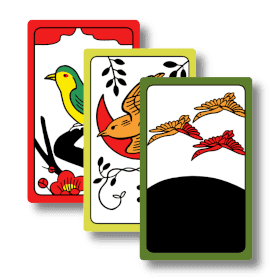 Go-Stop est le jeu Hanafuda le plus populaire dans le monde de langue coréenne, le plus souvent joué avec du Hanafuda en plastique connu sous le nom de Hwatu. Go-stop est également connu sous le nom de Godori, qui signifie « 5 oiseaux », qui est le nom d'un yaku utilisé dans ce jeu et dans d'autres.
Go-Stop est une version plus complexe de Koi-Koi qui combine certains éléments de Hachi-Hachi. Il doit son nom à son mécanisme de jeu caractéristique qui permet à un joueur d'arrêter la manche après avoir récupéré un yaku, ou de continuer la manche pour tenter d'augmenter encore son score, au risque que son adversaire marque à sa place.
Les images Hwatu de Marcus Richert et Hanafuda de Louie Mantia Jr. sont utilisées sous licence Art libre 1.3, compatible avec la licence CC BY-SA 4.0.
Les effets sonores Hwatu de la JICA (Jeonju) sont utilisés sous licence coréenne du gouvernement ouvert de type 1.
Nombre de joueurs: 2 - 6
Durée de la partie : 12 mn
Complexité : 2 / 5
Jouez à Go-Stop ou à 1403 autres jeux en ligne.
Sans téléchargement, directement depuis votre navigateur.
Avec vos amis et des milliers de joueurs du monde entier.
Gratuitement.

Jouez à Go-Stop ou à 1403 autres jeux en ligne.
Sans téléchargement, directement depuis votre navigateur.
Avec vos amis et des milliers de joueurs du monde entier.
Gratuitement.
Résumé des règles
Go-Stop (Hanafuda) - Quick Rules
Overview
- Players: Ideally 3 players (2-player variants exist).
- Deck: Hanafuda deck (48 cards, 12 suits/months).
- Objective: Be the first to reach a minimum point threshold (usually 3 points) and decide whether to continue ("Go") or end the round ("Stop").
Gameplay
On your turn, perform the following steps:
- Play from Hand: Match a card from your hand with a card of the same suit (month) on the table. If no match exists, discard it face up.
- Draw from Deck: Flip the top card of the draw pile. If it matches a card on the table, you take both.
- Collect: Any matches made are placed face up in your scoring area, categorized by type.
Card Types & Scoring
- Brights (Gwang - 5 cards): 3 cards = 3 pts (if "Rain-Bright" is included: 2 pts), 4 cards = 4 pts, all 5 cards = 15 pts.
- Animals (Yul - 9 cards): 5 cards = 1 pt, each additional = +1 pt.
- Special (Godori): The 3 specific bird cards (Jan, Feb, Aug) together = 5 pts.
- Ribbons (Ti - 10 cards): 5 ribbons = 1 pt, each additional = +1 pt.
- Red Ribbons (Hong-dan): 3 red ribbons with writing (Jan, Feb, Mar) = 3 pts.
- Blue Ribbons (Cheong-dan): 3 blue ribbons (Jun, Sep, Oct) = 3 pts.
- Grass Ribbons (Cho-dan): 3 red ribbons without writing (Apr, May, Jul) = 3 pts.
- Chaff (Pi - 24+ cards): 10 cards = 1 pt, each additional = +1 pt. (Double-Pi count as 2 cards).
Go or Stop?
When you reach at least 3 points (7 points in 2-player games), you must announce:
- Stop: The round ends immediately, and you win your score.
- Go: Play continues. You gain bonuses (+1 pt for "1-Go" and "2-Go", score doubling starting at "3-Go"). If you call "Go" and an opponent scores before you "Stop," you lose everything ("Go-bak").
Strategic Special Rules
- Puck (Bomb): If you hold 3 cards of a suit in hand and the 4th is on the table, you can "bomb" the suit and take all four. You draw two cards from the deck afterwards.
- Kiss (Chok): If the card you play from hand and the card you draw from the deck both match the same card on the table, you take all three.