
Isle of Bears
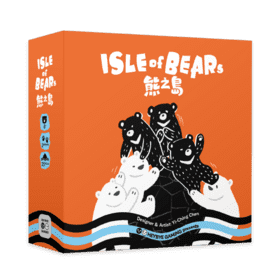 Été 2050. L’océan Arctique est presque entièrement libre de glace, et un groupe d’ours blancs sans abri s’est installé sur l’île des ours noirs. Une seule île ne peut accueillir deux espèces d’ours.
Isle of Bears est un jeu abstrait et intense pour deux joueurs qui se dispute sur seize cases et quatre petites îles. À chaque tour, vous jouez une carte Action : faites avancer une pile en ligne droite ou en diagonale, faites-la sauter n'importe où sur le plateau, échangez deux cases, regroupez les ours voisins en une seule pile, ou poussez une rangée entière jusqu'à ce que l'ours situé à l'extrémité tombe à la mer. Les ours s'empilent, et seul celui qui se trouve au sommet contrôle sa case ; ainsi, une simple poussée peut renverser toute une situation.
Les deux mains sont découvertes ; rien n’est caché, sauf l’ordre de votre paquet. Si vous surpeuplez une case, les ours se noient ; si vous videz une île, elle coule pour de bon. Pour gagner, vous devez recouvrir chaque case occupée de vos propres ours.
Nombre de joueurs: 2
Durée de la partie : 11 mn
Complexité : 1 / 5
Jouez à Isle of Bears ou à 1421 autres jeux en ligne.
Sans téléchargement, directement depuis votre navigateur.
Avec vos amis et des milliers de joueurs du monde entier.
Gratuitement.

Jouez à Isle of Bears ou à 1421 autres jeux en ligne.
Sans téléchargement, directement depuis votre navigateur.
Avec vos amis et des milliers de joueurs du monde entier.
Gratuitement.
Résumé des règles
Full rules and an animated card guide: isle-of-bears.heybyedesign.com/rules
Isle of Bears is a two-player abstract. Summer, 2050 — the Arctic is nearly ice-free, and homeless white bears have climbed aboard the black bears' isle. One isle cannot hold two kinds of bear.
Objective
Win the moment every occupied space is topped by bears of your colour. The bear on top of a stack controls that space, and every bear beneath it.
Board
- 4 isles, each 2×2, making a 4×4 grid of 16 spaces.
- 16 bears start on the board, one per space — 8 white, 8 black.
- Each player has a deck of 13 action cards and a hand of 3, face up. Both hands are public information; only the deck order is hidden.
Turn sequence
Play one card, then resolve these steps in order:
- Play a card — choose one of your three face-up cards and resolve its effect. A card affects all bears on a space; a stack always moves together.
- Overcrowding — a space safely holds 5 bears. If any space holds 6 or more after the effect resolves, all of the opponent's bears on that space are removed from the game (they fall into the sea). Only the active player's bears stay.
- Sinking isles — any isle with no bears left on it sinks and is removed from play. Its spaces no longer exist.
- Discard & draw — the cards used this turn go to their owner's discard pile, then you draw back up to 3. If your deck runs out, reshuffle your discard pile into a new deck.
Play then passes to your opponent.
Card effects
Each player has the same 13 cards. See the animated card guide for a before → after board for every card.
- Straight — Move the whole stack any distance up, down, left or right — landing on other stacks on top.
- Diagonal — Same idea, but along the four diagonals.
- Leap — Any direction, any distance — move the stack to any space on the board.
- Swap — Two spaces trade their entire stacks.
- Party — The four orthogonal neighbours all pile onto the centre; you choose the stacking order.
- Push — Your own bear is the pusher and moves along; all eight directions work (an empty direction is a plain one-step move), and a bear pushed off the isle falls into the sea.
- Dismiss — Released one at a time from the bottom up — each bear goes next to the previous one (restacking allowed), spreading out like a path.
- Banish — Pick a space: every bear there, including your own, goes into the sea.
- Play Twice — Activate other cards in front of you, two activations in total — two different cards, or the same one twice.
- Discard a Card — Send one of your opponent's face-up cards to their discard pile; they draw only at the end of their turn.
- Wild Card — Activate any face-up card from either player — Play Twice included. On an opponent's card, black and white swap. Everything used is discarded together.
Rulings worth knowing
- "Your bears" is decided by the colour on top of a stack. When Wild Card activates an opponent's card, "your" always means the player who played the Wild Card.
- Straight and Diagonal may pass over sunken gaps, but must land on a space that still exists.
- Push: the pushed line stops at the first empty space (bears beyond it are unaffected). The pusher's destination must exist, so directions that would push it off the board are not offered.
- Dismiss: a bear may be placed back onto a space you already used, and stacks may re-form as you go.
- Swap needs bears on both spaces.
- Wild Card may activate Play Twice, but Wild cannot activate another Wild, and Play Twice cannot activate Play Twice or Wild — that would allow infinite chains.
- A card with no legal target may still be played — the effect fizzles, and the card is discarded as usual.
- If a player would start their turn with no cards (possible via Wild → opponent's Play Twice → your Discard a Card twice), that turn is skipped and their hand is refilled to 3.
Winning
The moment every occupied space is topped by the same colour, that player wins immediately. If no bears are left at sea level at all, the game is a draw.
Tie-breaker — the number of spaces you control at the end of the game.
On BGA
- Both hands are face up by design — this is not a hidden-information game.
- If a player quits, a zombie takes over so the table can finish. It plays a random legal move; it is not an AI opponent.