
Périclès
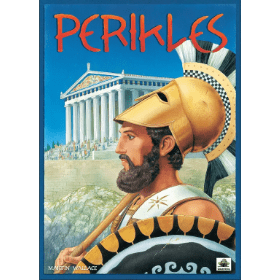 Périclès est un jeu de Martin Wallace. Les joueurs jouent le rôle d'une famille noble cherchant à devenir le chef d'une ou de plusieurs des six cités états de la Grèce antique. Le jeu se déroule en deux phases :
Dans le premier, les joueurs se disputent le contrôle de zone dans chacun des six États, qui se terminent par des élections. Les joueurs qui remportent les élections dans chaque État peuvent alors contrôler l'armée de cet État.
Dans la deuxième phase, les joueurs utilisent des cartes pour déplacer leurs armées afin d'attaquer ou de défendre l'une des sept batailles (chacune liée à un État, et vous ne pouvez pas attaquer le vôtre !) qui sont à gagner cette manche-ci.
La mécanique de jeu est simple, avec des éléments tirés d'autres wargames de style européen (notamment Struggle of Empires de Martin Wallace). Ce qui rend Périclès unique, c'est l'intégration harmonieuse de la phase de contrôle/vote de zone et de la phase militaire.
Nombre de joueurs: 3 - 5
Durée de la partie : 17 mn
Complexité : 4 / 5
Jouez à Périclès ou à 1394 autres jeux en ligne.
Sans téléchargement, directement depuis votre navigateur.
Avec vos amis et des milliers de joueurs du monde entier.
Gratuitement.


Jouez à Périclès ou à 1394 autres jeux en ligne.
Sans téléchargement, directement depuis votre navigateur.
Avec vos amis et des milliers de joueurs du monde entier.
Gratuitement.
Résumé des règles
Perikles
In Perikles, players represent influential Greek families. Over three epochs, they strive to gain political control in six city-states and lead the armies of these cities to victory in various battles.
Game Objective
Win by accumulating the most Victory Points (VP). Points are awarded at the end of each epoch for won battles (Statue tokens) and at the end of the game for controlling city-states.
Game Flow
The game is played over three epochs. Each epoch consists of two main phases: the Political Phase and the War Phase.
1. Political Phase (Influence & Control)
During this phase, players place their influence cubes to take leadership of the cities.
- Selecting Influence Tiles: Players take turns picking tiles that indicate which cities they can place cubes in.
- Placing Cubes: Cubes are placed in the six cities (Athens, Sparta, etc.).
- Elections: In each city, the player with the most cubes is checked.
- The player with the most cubes becomes the Leader of the city for that round.
- They receive the city's two Army Tiles (Land and Sea forces).
- Specific tie-breaking rules apply if necessary.
- Ostraka (Exile): Players can attempt to remove opposing cubes from cities to secure a majority.
2. War Phase (Battles & Strategy)
The leaders of the cities now deploy their armies to launch attacks against Persia or other Greek locations on the board.
- Deploying Armies: Players place their Army Tiles face-down on available locations. Battles are categorized as Land or Sea combat.
- Resolving Battles: Tiles are revealed. Combat is resolved by comparing combat strength (Strength values on tiles + a die roll).
- Attacker vs. Defender: The attacker must overcome the location's defense or the opposing armies present.
- Casualties: Defeated units are removed from the board.
- Rewards: The winner of a battle receives a Statue token, which provides VP at the end of the epoch.
Actions & Decision Factors
Influence Tile Categories
Tiles offer various tactical options:
- City Symbols: Allow placing 1 or 2 cubes in the corresponding city.
- Event Tiles:
- Plague: Reduces the number of cubes in a chosen city for all players.
- Treachery: Allows weakening or manipulating an army in battle.
- Persian Fleet: Can be used in sea battles to influence the outcome.
Military Units
- Hoplites (Land): Used for land battles in the regions.
- Triremes (Sea): Used for naval battles to secure control over the seas.
- Sparta Special Rule: Spartan land units are exceptionally strong in combat but have less political flexibility.
End of Game & Scoring
Final scoring takes place after the third epoch:
- Statue Points: Sum of points from all three epochs.
- City Control: Players holding leadership in a city at the end of the third epoch receive bonus VP based on the city's value.
- Remaining Influence: Minor points for leftover resources.
The player with the most total Victory Points is the winner.