
Pisanki
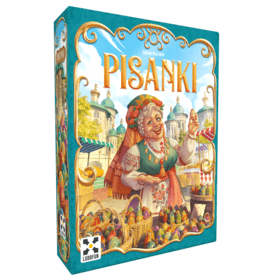 Le pisanki est l'art traditionnel de la peinture des œufs de Pâques, célébré par les peuples slaves, principalement en Pologne et en Ukraine.
Dans ce jeu, vous préparerez la plus belle présentation d'œufs Pisanki pour ravir les gens du monde entier.
À chaque manche, les joueurs dévoilent et acquièrent de nouvelles cartes représentant des œufs décorés, des fleurs et des nappes afin de composer leur table de présentation.
Selon l'ordre dans lequel les cartes sont acquises, le joueur pourra également gagner des points de mouvement pour trier les cartes acquises sur sa table, qui seront comptabilisés à la fin de la partie en fonction de leur position par rapport aux autres cartes et selon les cartes de score définies au début de la partie.
Le joueur ayant le plus de points sera déclaré vainqueur.
Nombre de joueurs: 2 - 5
Durée de la partie : 7 mn
Complexité : 1 / 5
Jouez à Pisanki ou à 1414 autres jeux en ligne.
Sans téléchargement, directement depuis votre navigateur.
Avec vos amis et des milliers de joueurs du monde entier.
Gratuitement.


Jouez à Pisanki ou à 1414 autres jeux en ligne.
Sans téléchargement, directement depuis votre navigateur.
Avec vos amis et des milliers de joueurs du monde entier.
Gratuitement.
Résumé des règles
🌅 Pisanki - Règles rapides
Le Pisanki est un jeu de cartes stratégique où les joueurs collectionnent et disposent des œufs de Pâques décorés (Pisanki) sur leur table de jeu pour marquer le plus de points grâce à un placement astucieux et à des majorités.
🌅 Déroulement du jeu
La partie se déroule en plusieurs manches. Chaque manche comprend les phases suivantes :
▶ 1. Phase de préparation
Selon le nombre de joueurs, des cartes sont piochées et placées face visible à côté des cartes Offre numérotées (de 1 à 5).
Ces cartes présentent des combinaisons d'œufs, de fleurs et de différents motifs de nappes.
▶ 2. Phase d'acquisition Chaque joueur, en commençant par le premier, choisit une carte parmi celles disponibles.
Choisir une carte avec un numéro plus bas permet de jouer plus facilement lors de la manche suivante.
▶ 3. Phase de placement et de tri La carte acquise doit être placée immédiatement sur la table de jeu du joueur (une grille 3x4). Utilisation des points de mouvement : Si le joueur a acheté 1 carte, il dispose de 2 déplacements. S'il a acheté 2 cartes, il dispose d'1 déplacement.
1 déplacement : Une carte peut être déplacée verticalement ou horizontalement vers n'importe quelle position dans cette direction ; les autres cartes de la colonne ou de la ligne doivent être déplacées pour combler l'espace vide.
2 points : La même carte peut être déplacée deux fois (si le joueur dispose de 2 déplacements).
🌅 Catégories et symboles
Lors du choix des cartes, les joueurs doivent tenir compte des éléments suivants :
🥚 Types d'œufs : Il existe 6 motifs/couleurs différents. Ils sont essentiels pour le calcul de la majorité.
🌹 Fleurs : Présentes sur certaines cartes, elles rapportent des points bonus en fonction des cartes Fleurs actives.
🌈 Nappes (Fonds) : La couleur ou le motif du fond influence le calcul des points liés aux nappes (par exemple, les groupes de couleurs identiques).
🥚🥚 Œufs doubles : Les cartes représentant deux œufs comptent double pour les vérifications de majorité.
🌅 Fin de partie et calcul des scores
Après 12 manches, l'écran 3x4 est rempli. Le score est calculé selon quatre catégories :
Majorité d'œufs 🥚 : Le joueur qui possède le plus d'œufs d'un type spécifique remporte les points de la carte correspondante.
Points des fleurs 🌹 : Points attribués en fonction du nombre total de fleurs collectées.
Points de la nappe 🌈 : Points attribués pour la disposition et les motifs des fonds de carte.
Points d'affichage : Points attribués pour la réalisation d'objectifs spécifiques (par exemple, placer des œufs spécifiques dans les coins de la grille).
Le joueur qui obtient le score total le plus élevé remporte la partie.