
Seotda
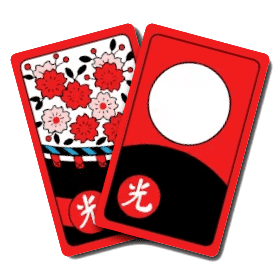 Le Seotda (aussi connu sous le nom de Sutda) est un jeu de pari coréen similaire au Oicho-Kabu. Joué initialement avec un Tujeon, le jeu utilise aujourd'hui des cartes Hwatu ou Hanafuda à la place. Les joueurs parient sur la valeur des cartes distribuées au cours de plusieurs manches comme au Poker ou dans les autres jeux de confrontation. Les mains de Seotda sont constituées de 2 cartes.
Cette implémentation supporte aussi le Dorijitgo-ttaeng, requérant que les joueurs forment une combinaison de 3 cartes dont la valeur totale est divisible par 10, puis qu'ils utilisent les deux cartes restantes dans leur main de 5 cartes.
Les illustrations Hwatu de Marcus Richert et les illustrations Hanafuda de Louie Mantia Jr. sont utilisées avec la licence Free Art 1.3, qui est compatible avec la licence CC BY-SA 4.0.
Les effets sonores Hwatu par JICA (Jeonju) sont utilisés sous Licence Ouverte de Type 1 du Gouvernement de Corée.
Nombre de joueurs: 2 - 8
Durée de la partie : 5 mn
Complexité : 1 / 5
Jouez à Seotda ou à 1408 autres jeux en ligne.
Sans téléchargement, directement depuis votre navigateur.
Avec vos amis et des milliers de joueurs du monde entier.
Gratuitement.

Jouez à Seotda ou à 1408 autres jeux en ligne.
Sans téléchargement, directement depuis votre navigateur.
Avec vos amis et des milliers de joueurs du monde entier.
Gratuitement.
Résumé des règles
Game Overview
In the high-stakes world of Korean gambling, players face off in Seotda, a tense battle of luck and psychological warfare. Thematically, you act as a bold gambler aiming to create the most powerful combination using only two cards. Mechanically, the game utilizes a condensed Hanafuda deck where strategic betting and calculated bluffing are essential to force opponents to fold before the showdown.
Goal of the Game
The goal is to hold the highest-ranking combination of two cards or to win the pot by bluffing opponents into folding.
Gameplay
Preparation
- A reduced deck of 20 Hanafuda cards is used (months 1 through 10, two cards per month).
- Each player is dealt 2 cards (in the 3-card variation, one card is discarded before the final bet).
Betting Phase
Once cards are dealt, players choose their actions:
- Die: Fold and forfeit the current stake.
- Call: Match the current bet.
- Raise: Increase the stakes.
- All-in: Bet all remaining capital.
End of Round
If multiple players remain after the betting phase, a showdown occurs. Hands are revealed, and the player with the strongest combination takes the entire pot.
Combinations (Ranking)
| Rank | Name | Description |
|---|---|---|
| 1 | 3-8 Gwang-ddeng | The ultimate hand, consisting of the special cards from months 3 and 8. |
| 2 | 1-3 / 1-8 Gwang-ddeng | The second-highest tier (special cards from months 1 & 3 or 1 & 8). |
| 3 | Ddeng | Two cards from the same month (e.g., two 10s = Jang-ddeng). |
| 4 | Ggeut | The sum of the two cards' months (last digit only). A 9 is the highest standard value (Gabi). |
Game End & Scoring
- The game ends after a fixed number of rounds or when only one player has capital left.
- Re-deal: In the event of a tie for the highest hand, the pot is typically carried over to the next round rather than split.